


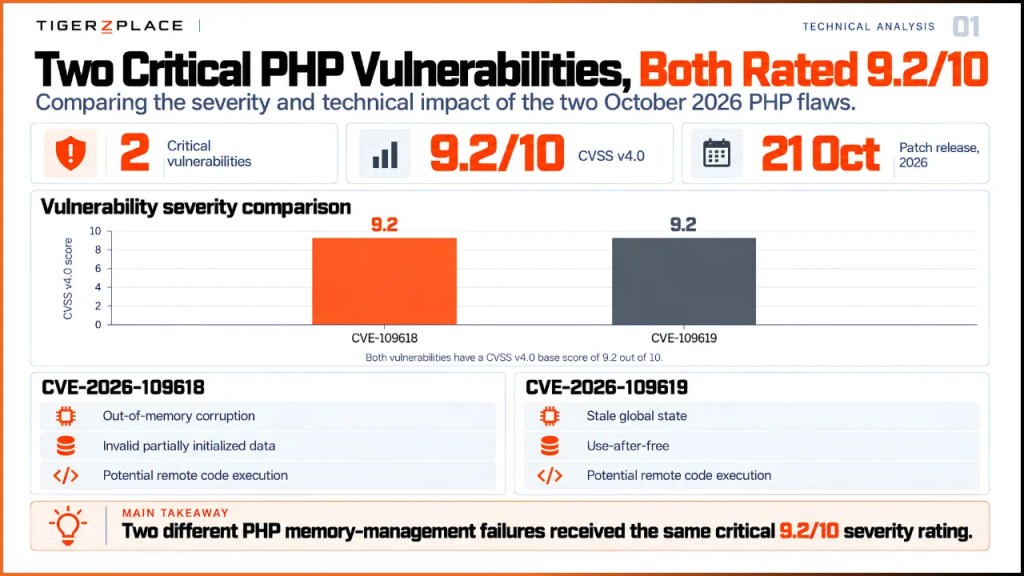
On October 21, 2026, the PHP development team released emergency security updates for PHP2Shell, a pair of critical vulnerabilities that could allow attackers to execute unauthorized commands on vulnerable web servers without authentication. Both flaws received a critical severity score of 9.2 out of 10 under CVSS v4.0.
The vulnerabilities, identified as CVE-2026-109618 and CVE-2026-109619, affected PHP’s internal memory-management system rather than a particular website plugin or application. This meant that websites using WordPress, Drupal, Joomla, Laravel, and other PHP-based technologies could remain vulnerable even after developers updated their application code.
Amazon Threat Intelligence raised concerns about the urgency of the threat after discovering an exploitation attempt from October 17, four days before vendors released the official security patches. Following public disclosure, researchers documented successful remote shell executions and targeted attacks involving exposed firewall management infrastructure.
By October 29, Palo Alto Networks had identified more than 22.6 million potentially vulnerable exposed instances through its security telemetry. However, this represented estimated exposure rather than confirmed compromises, and researchers emphasized that successful exploitation depended on the specific PHP environment.
The incident demonstrated how vulnerabilities deep inside widely used software can create risks across otherwise unrelated websites and services. For developers and website administrators, the immediate priorities are understanding the flaws, identifying affected installations, applying security updates, and checking for signs of earlier exploitation.
What Is PHP2Shell?
PHP2Shell is the collective name for two critical remote code execution vulnerabilities affecting PHP’s core request-processing and memory-management systems. PHP is a server-side programming language that processes web requests and generates dynamic content for websites, including blogs, business platforms, online stores, and content management systems.
When someone visits a PHP-powered website, the server processes incoming requests and allocates temporary memory for variables, uploaded files, form submissions, and internal data structures. After the operation finishes, PHP releases the memory for reuse in other requests.
Vulnerabilities arise when errors interrupt this process and leave internal memory in an unsafe state. Under certain conditions, attackers can trigger these failures with specially crafted HTTP requests, potentially causing memory corruption, unauthorized memory access, or remote code execution.
Remote code execution, commonly abbreviated as RCE, means an attacker may be able to run commands on a remote system without permission. In a vulnerable PHP environment, successful exploitation could provide access to files, application credentials, or other resources available to the affected server process.
The two vulnerabilities involve different technical problems. CVE-2026-109618 concerns improper handling of out-of-memory conditions, while CVE-2026-109619 involves references to memory that has already been freed.
| Vulnerability | Technical problem | Potential impact | Severity |
|---|---|---|---|
| CVE-2026-109618 | Out-of-memory handling leaves internal data partially initialized | Memory corruption, information disclosure, or remote code execution | Critical, 9.2 |
| CVE-2026-109619 | Internal references continue pointing to freed memory | Use-after-free, memory disclosure, crashes, or remote code execution | Critical, 9.2 |
The official PHP security announcement confirmed that both flaws could allow unauthenticated remote code execution under vulnerable conditions. However, the same exploitation technique does not necessarily work against every affected installation because server configuration and memory behavior influence exploit reliability.
Why Was the PHP2Shell Attack So Dangerous?
The seriousness of the incident came from PHP’s widespread adoption and the location of the vulnerabilities. PHP powers a substantial proportion of websites whose server-side programming language can be identified, including major content management systems, business applications, educational portals, and online stores.
Some early reports suggested that approximately 70% of the internet was vulnerable because PHP is used by such a large share of websites. However, PHP’s market share does not establish how many servers were unpatched or whether attackers could exploit every installation.
A website may use PHP without running a vulnerable release, while other deployments may have configurations that prevent particular exploitation techniques from succeeding. Nevertheless, a vulnerability inside a widely deployed runtime creates a broader potential attack surface than one affecting a specific application.
Why PHP2Shell could bypass website authentication
Website authentication normally happens inside application code after the web server begins processing a request. Login systems, access controls, and application-level checks determine whether a visitor has permission to perform an action or access protected information.
However, PHP must perform certain internal operations before the application’s authentication logic executes. Researchers demonstrated that vulnerable Apache mod_php configurations could reach the affected memory-management behavior during this earlier request-processing stage.
As a result, attackers did not necessarily need valid account credentials to trigger the vulnerability. Strong passwords, two-factor authentication, and updated security plugins remained important, but those measures could not repair flaws inside the PHP interpreter itself.
What could attackers potentially access?
Successful exploitation could allow an attacker to execute commands with the permissions assigned to the affected PHP worker. Depending on server configuration, this may expose application files, database credentials, authentication tokens, API keys, or other sensitive information accessible to the process.
Attackers might also attempt to modify writable website files, install malicious server-side scripts, or establish persistent access after the original intrusion. However, remote code execution does not automatically provide root or administrator privileges, and additional access may require further vulnerabilities.
This distinction matters when assessing real-world incidents because the impact depends on the permissions and resources available to the compromised process. Systems with unnecessary privileges or publicly accessible administrative services may face additional risks following an initial compromise.
How Does PHP2Shell Work?
Both vulnerabilities involve unsafe memory handling inside PHP, although they arise through different technical mechanisms. Understanding the basic request-processing workflow helps explain how an ordinary-looking HTTP request can reach a dangerous condition inside the PHP runtime.
A PHP worker processes incoming requests and allocates temporary memory for the information required by each operation. This can include form fields, uploaded-file metadata, session values, and internal objects that help PHP interpret and execute application code.
After the request finishes, the worker releases temporary memory that is no longer required. Normally, PHP must ensure that references to released memory are cleared and that incomplete operations do not leave invalid internal data behind.
The security problems emerge when those safeguards fail. One vulnerability involves partially initialized memory after a failed allocation, while the other involves outdated references that survive after memory has been released.
How PHP2Shell triggers out-of-memory corruption
CVE-2026-109618 involves a memory-management failure associated with out-of-memory conditions. When PHP processes certain incoming requests, it creates internal structures to store and organize information supplied by the client, including metadata associated with multipart form submissions.
PHP normally limits how much memory each request can consume. If an operation reaches the configured memory limit, the runtime should terminate that operation safely rather than continue allocating resources beyond the allowed amount.
However, researchers discovered that a memory-allocation failure occurring at a particular stage could interrupt the creation of an internal structure before initialization was complete. The subsequent cleanup operation might then treat the unfinished structure as though it contained valid data.
This mismatch can lead to memory corruption when PHP reads or manipulates data before the system initializes it correctly. Unlike ordinary memory exhaustion, which should result in a controlled failure, the vulnerable behavior can leave PHP’s internal state inconsistent.
Researchers identified request-processing paths capable of reaching these conditions through unusual HTTP traffic. Attackers needed more than a large request to exploit the vulnerability successfully. They had to trigger the failure at a specific point where they could manipulate the resulting invalid state.
How PHP2Shell exploits use-after-free memory
CVE-2026-109619 involves another memory-safety weakness known as use-after-free. This happens when software continues to use a reference to memory it has already released, which can cause the program to interpret new data incorrectly.
For example, a PHP worker may store a reference to temporary information created during one request. Once that request finishes, PHP releases the memory, but an internal reference may survive because the expected cleanup or initialization did not occur correctly.
When another request reaches the same worker, the released memory location may contain different information. If PHP follows the outdated reference, it may interpret the replacement data as though it were the original internal object, creating opportunities for memory corruption or unauthorized access.
Researchers examining this vulnerability discussed heap grooming, a technique involving the arrangement of dynamically allocated memory. An attacker can influence how the system reuses memory, increasing the chances that specific data occupies a memory location associated with the vulnerability.
Another important component is PHP’s internal zval structure, which represents values and their data types. PHP uses this information to distinguish between integers, strings, arrays, objects, and other values so that the runtime handles them correctly.
If memory corruption causes PHP to interpret an arbitrary address as a valid string or object reference, sensitive process information may become accessible. Such disclosures can sometimes help attackers overcome address-space layout randomization, commonly called ASLR, which makes memory locations harder to predict.
However, obtaining an outdated memory reference does not automatically provide code execution. A successful attack still requires additional technical conditions, including suitable memory behavior and a way to turn the corrupted state into a meaningful security impact.
Why PHP2Shell exploits differ between servers
Researchers found that successful exploitation could vary considerably between different PHP environments. PHP versions, installed extensions, worker configurations, memory layouts, and request-processing behavior can all influence whether a particular technique works against a target.

Researchers identified Apache mod_php as a particularly concerning configuration because they demonstrated attacks that could occur before the application code started running. Other execution environments, including PHP-FPM, php-cgi, FrankenPHP, and LiteSpeed, also required updates, although their exploitation requirements could differ.
Tenable’s October 29 research highlighted these limitations after testing vulnerable systems and examining publicly circulated proof-of-concept code. The researchers found that working exploits often needed adjustments for the target’s specific PHP environment rather than functioning reliably across every server.
Quick recap: One vulnerability involves incomplete internal data following memory exhaustion, while the other involves references to memory that has already been freed. Both can lead to serious consequences, but successful exploitation depends on the exact conditions present in the affected PHP environment.
PHP2Shell Attack Timeline: What Happened in October 2026?
Although the vulnerabilities became public in October 2026, their underlying causes had existed for years. During PHP security work related to a 2024 external audit, researchers discovered similar memory-handling issues, but they had not yet identified all the possible exploitation paths.
The situation changed in August 2026 when independent researchers identified serious vulnerabilities and reported their findings to the PHP security team. Calif, OpenAI, and Wiz contributed research during the investigation, helping establish that the memory-management weaknesses could lead to remote code execution.
The PHP security team coordinated with researchers and infrastructure providers to develop fixes for supported PHP branches.The team initially planned to release the information publicly on October 22, but details about the vulnerabilities began circulating before the scheduled disclosure.
As concerns increased, the PHP project moved the security release forward to October 21. This gave administrators earlier access to the official patches while also creating additional pressure on software distributors and hosting providers.
| Date | Major development |
|---|---|
| 2024 | Early indications of related memory-management problems were identified |
| August 11, 2026 | Calif reported an exploitable vulnerability to the PHP security team |
| August 19–24, 2026 | Wiz independently discovered and reported related findings |
| October 17, 2026 | Amazon later identified an exploitation attempt in MadPot telemetry |
| October 20, 2026 | Vulnerability identifiers circulated ahead of coordinated disclosure |
| October 21, 2026 | PHP released emergency security patches |
| October 22–23, 2026 | Vendors reported widespread scanning and attempted exploitation |
| October 24, 2026 | Research honeypots recorded successful remote shell executions |
| October 26, 2026 | CISA added both vulnerabilities to its Known Exploited Vulnerabilities catalog |
| October 29, 2026 | Researchers published further findings on exploit reliability and targeted attacks |
The disclosure process became controversial when technical information circulated before the official release. On October 20, someone posted the vulnerability identifiers online with incorrect severity information and mistakenly published a demonstration video, which they later removed.
Another complication arose when Chainguard published container images containing the security fixes more than six hours before the coordinated release. This raised concerns because attackers could potentially compare patched and vulnerable software to understand the changes before all organizations could obtain the official updates.
The PHP Foundation’s disclosure report described the difficulties involved in coordinating a security release across researchers, maintainers, and infrastructure providers. The incident demonstrated how quickly vulnerability information can spread and how disclosure timing can affect defenders.
Confirmed PHP2Shell Attacks and Real-World Incidents
Following public disclosure, security organizations observed substantial volumes of suspicious traffic targeting PHP installations. However, automated scanning, attempted exploitation, and confirmed compromise are different types of evidence, and they should not be treated as interchangeable.
A suspicious HTTP request does not establish that an attacker executed commands or accessed sensitive information. Researchers therefore examine server responses, process activity, and other evidence before determining whether an exploitation attempt was successful.
Amazon detected exploitation attempts before disclosure
Amazon Threat Intelligence identified an attempted exploit on October 17 through its MadPot honeypot network. The activity occurred four days before PHP released the security patches and originated from infrastructure associated with a commercial anonymization network.
Amazon could not determine how the actor obtained information about the vulnerabilities before public disclosure. However, its telemetry also recorded additional proof-of-concept activity around October 21, suggesting that different actors were attempting to reproduce the attack.
The Amazon Threat Intelligence investigation established that attempted exploitation preceded the coordinated release. Nevertheless, the early observations did not prove that the attempts would have successfully compromised ordinary production servers.
Researchers confirmed successful shell executions
On October 24, security researcher Adel Karimi documented successful exploitation against intentionally vulnerable PHP honeypots. The monitored environments used PHP 8.4.26 with Apache mod_php and a single-worker configuration that made certain attack conditions easier to reproduce.
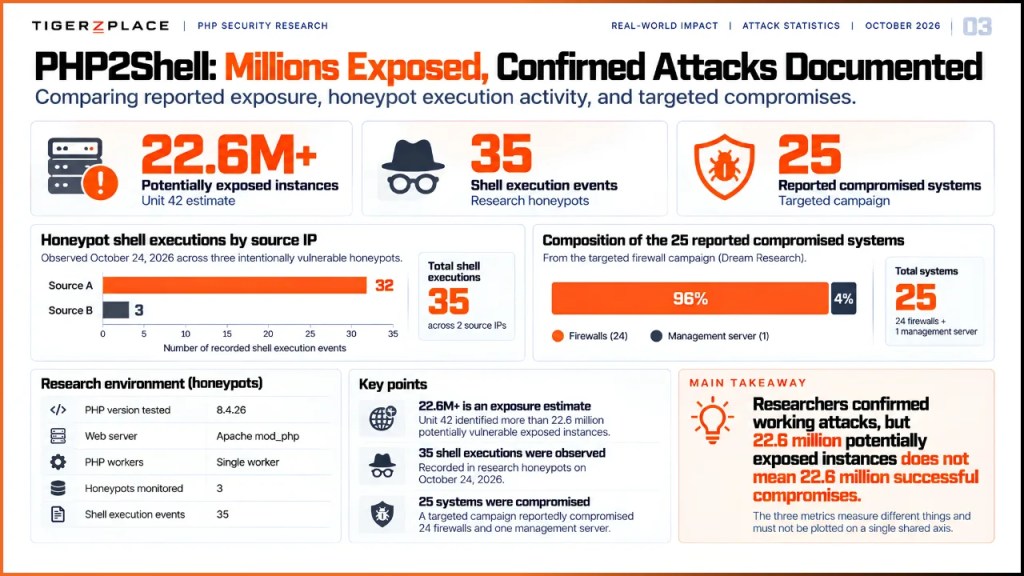
Across three sensors, researchers recorded 35 successful shell executions. These findings provided evidence of actual remote command execution rather than only memory errors, crashes, or suspicious requests.
However, researchers deliberately configured the test environments to make exploitation easier. The results therefore established that the vulnerabilities were practically exploitable under those conditions, not that every unpatched PHP server would behave identically.
Attackers compromised firewall management infrastructure
A more serious real-world incident emerged when Dream Research investigated a campaign targeting exposed firewall management systems. The researchers reported that attackers combined the PHP vulnerabilities with a separate Linux privilege-escalation issue known as Fragnesia, tracked as CVE-2026-46300.
According to the investigation, attackers compromised 24 firewalls and an additional management server. Attackers reportedly used their access to obtain higher privileges, establish persistence, and investigate connected internal infrastructure.
Palo Alto Networks subsequently confirmed active exploitation involving exposed PAN-OS management interfaces and independently corroborated important findings from the campaign. The incidents demonstrated why publicly accessible administrative interfaces can create significant risks beyond the original vulnerable service.
More than 22.6 million potentially exposed instances
On October 29, Palo Alto Networks reported identifying more than 22.6 million potentially vulnerable exposed instances through Cortex Xpanse telemetry. The estimate illustrated the possible scale of exposure, but it did not represent the number of confirmed compromised websites.
Different PHP environments may have distinct exploitation requirements, while some exposed instances may already have additional restrictions or vendor-specific fixes. The Unit 42 threat briefing therefore highlights the need for urgent patching but does not confirm that attackers successfully exploited every identified vulnerable instance.
| Security finding | Reported observation | What it establishes |
|---|---|---|
| October 17 activity | Amazon identified a pre-disclosure exploitation attempt | Attempted exploitation before public release |
| October 24 honeypots | 35 successful shell executions | Confirmed execution in intentionally vulnerable environments |
| Firewall campaign | 24 firewalls and one management server reportedly compromised | Targeted real-world exploitation |
| October 29 exposure estimate | More than 22.6 million potentially vulnerable instances | Estimated exposure, not confirmed breaches |
Quick recap: Researchers confirmed exploitation attempts before the public disclosure, successful remote shell execution in honeypots, and targeted attacks against network infrastructure. However, large exposure estimates and automated scanning activity do not establish an equivalent number of successful compromises.
Which PHP Versions Are Vulnerable?
The vulnerabilities involve PHP code paths dating back to older releases, including PHP 5.4-era implementations. However, the PHP development team released emergency security updates for four supported branches on October 21, 2026.
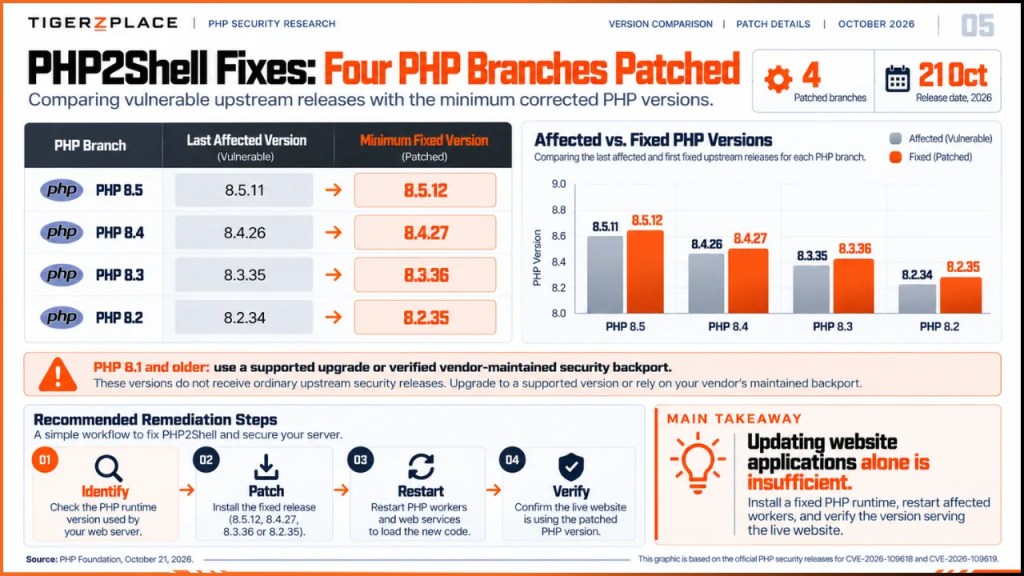
The table below lists the minimum upstream versions that include the original security fixes. These versions represent the first releases that addressed the vulnerabilities, but users should not consider them permanent recommendations or avoid upgrading to newer versions.
| PHP branch | Affected upstream releases | Minimum fixed version |
|---|---|---|
| PHP 8.5 | Earlier than 8.5.12 | 8.5.12 |
| PHP 8.4 | Earlier than 8.4.27 | 8.4.27 |
| PHP 8.3 | Earlier than 8.3.36 | 8.3.36 |
| PHP 8.2 | Earlier than 8.2.35 | 8.2.35 |
| PHP 8.1 and older | Unsupported upstream branches | Upgrade or obtain verified vendor-maintained security fixes |
Older PHP branches require additional attention because they no longer receive normal upstream security releases. Some Linux distributions and hosting providers maintain security backports, which may incorporate fixes without changing the displayed upstream version number.
Administrators should therefore confirm package revisions against trusted vendor advisories instead of relying exclusively on the PHP version string. Where possible, moving to a supported and regularly maintained PHP release provides a more sustainable security position.
Are WordPress, Drupal, and Laravel websites affected?
Websites using WordPress, Drupal, Joomla, Laravel, and custom PHP applications may remain vulnerable if they run on an outdated PHP version. Updating the application alone does not always fix the issue because developers and server administrators often manage the application and PHP interpreter separately.
A WordPress website may have all its plugins and themes up to date, but its hosting account may still run an outdated PHP version. Website owners should therefore check the actual runtime serving each domain and confirm the hosting provider’s security updates.
Readers unfamiliar with the language can explore TigerzPlace’s PHP tutorial for beginners for additional background on PHP’s role in web development.
How to Fix PHP2Shell and Protect Your Website
Installing a patched PHP runtime is the only complete remediation for the original two vulnerabilities. Security plugins, firewalls, and temporary configuration adjustments may reduce exposure, but they cannot correct memory-management flaws inside unpatched PHP code.
Website owners should begin by identifying which PHP versions actually serve their applications. This includes production websites, development environments, old demonstration sites, administrative portals, and any other PHP-powered services connected to their infrastructure.
Identify the PHP runtime serving your website
A single server may contain multiple PHP versions, while different websites can use separate PHP-FPM pools or Apache configurations. Administrators need to identify the runtime processing actual web traffic rather than assuming every application uses the same PHP installation.
On systems they administer, the command php -v provides an initial indication of the command-line PHP version. However, the command-line interpreter may differ from the runtime serving live web requests, so an additional production-environment check is necessary.
Install the appropriate security updates
After identifying the affected installations, administrators should obtain the necessary security fixes from the PHP project, their operating system vendor, or their hosting provider. The minimum upstream patched versions are PHP 8.2.35, 8.3.36, 8.4.27, and 8.5.12.
Organizations using unsupported branches should plan an upgrade or verify that their vendor supplies an appropriate security backport. Unofficial packages from unknown sources should be avoided because the integrity of the update is an essential part of the remediation process.
Restart PHP workers and verify the update
Installing updated packages does not always replace code already loaded by running processes. Existing PHP-FPM workers, Apache processes, or application containers may continue operating until the appropriate services are restarted or redeployed.
After restarting the relevant services, administrators should confirm that production requests are handled by patched PHP code. They should also verify the package revision and ensure that no outdated workers or application containers remain active.
Test website functionality after patching
Security updates should be followed by ordinary application testing to identify compatibility problems. Important functions include login systems, contact forms, uploads, scheduled tasks, administrative dashboards, and business-critical transactions.
For eCommerce websites, administrators should also verify shopping cart and checkout behavior through appropriate testing procedures. Recording the installed versions, restart times, and verification results creates a useful history for future vulnerability management.
| Priority | Recommended action | Purpose |
|---|---|---|
| Immediate | Identify all production PHP runtimes | Find potentially affected installations |
| Immediate | Install fixed PHP packages or verified backports | Repair the original vulnerabilities |
| Immediate | Restart affected PHP workers and containers | Ensure patched code is running |
| Immediate | Restrict unnecessary public management interfaces | Reduce exposure to targeted attacks |
| High | Review logs dating from October 17 onward | Investigate potential earlier exploitation |
| High | Verify WAF coverage and security monitoring | Provide additional detection and protection |
| High | Review the separate session upload-progress advisory | Address configuration-specific risks |
| If compromised | Preserve evidence and investigate credential exposure | Support containment and recovery |
For organizations managing multiple websites, maintaining an accurate inventory of software versions can make emergency updates easier to coordinate. TigerzPlace’s cybersecurity best practices guide provides further guidance on protecting online systems and reducing common security risks.

What If PHP Cannot Be Updated Immediately?
Some organizations may face compatibility difficulties when upgrading legacy PHP applications. Older systems can depend on deprecated functions, unsupported extensions, or server configurations that require additional testing before a major version upgrade.
However, delaying remediation leaves the original vulnerabilities present. The PHP project described temporary measures involving memory settings and request processing, but these should be understood as exposure-reduction techniques rather than complete fixes.
For example, changing the PHP memory limit may interfere with certain exploitation conditions, but it does not correct the underlying error-handling flaw. Removing memory restrictions can also create operational problems by allowing applications to consume unexpectedly large amounts of resources.
Similarly, restricting multipart uploads may reduce some attack opportunities while interfering with legitimate website functions. Administrators should evaluate these trade-offs and follow official vendor guidance rather than applying unverified configuration changes.
If an affected service cannot be patched or safely isolated, restricting public access or temporarily taking the service offline may be necessary. This is particularly relevant for internet-facing management interfaces and systems connected to sensitive organizational infrastructure.
How to Detect Possible PHP2Shell Exploitation
Patching prevents further exploitation of the original flaws, but it does not establish whether an attacker gained access before remediation. Organizations should review relevant security activity beginning at least October 17, 2026, because attempted exploitation was observed before public disclosure.
Detection can be difficult because memory-corruption attacks may leave limited evidence. A PHP worker crash or memory-limit error does not automatically indicate successful exploitation, while the absence of suspicious logs does not prove that a system was never compromised.
Reviewing suspicious HTTP requests
Administrators should examine web server and reverse-proxy logs for unusual multipart POST activity, unexpected upload patterns, and repeated requests associated with abnormal errors. Some attack paths involve PHP session upload-progress behavior, including requests containing the PHP_SESSION_UPLOAD_PROGRESS field.
However, this field can also appear in legitimate applications, so its presence alone does not prove malicious activity. Investigators should correlate suspicious requests with server responses, process activity, and other available security telemetry.
Examining PHP process behavior
Unexpected worker crashes, repeated memory-limit failures, and unexplained process restarts may provide useful investigative context. Security teams should examine whether these events occurred alongside suspicious incoming requests or unusual activity from the web-server account.
Potential evidence of successful compromise includes unexpected child processes, unauthorized modifications to application files, unfamiliar PHP scripts, or suspicious outbound connections. These observations should be investigated together because no single indicator can reliably establish the complete attack sequence.
Investigating possible credential exposure
If credible evidence suggests a successful intrusion, administrators should determine which resources the affected PHP process could access. Application configuration files may contain database passwords, API keys, authentication tokens, and service credentials that could allow further unauthorized activity.
Patching the original vulnerability does not invalidate credentials that an attacker may already have obtained. Incident responders should preserve evidence, investigate potential exposure, and rotate affected secrets where appropriate.
TigerzPlace’s article explaining how hackers steal passwords provides additional context on how exposed credentials can increase the impact of an initial security incident.
Quick recap: Effective remediation requires both installing the security fix and checking whether exploitation occurred before patching. Log reviews, process monitoring, file-integrity checks, and credential assessments provide complementary evidence, although no single method can guarantee that a system was never compromised.
Can Cloudflare or a Web Application Firewall Prevent PHP2Shell?
Web application firewalls can reduce exposure to known malicious request patterns, but they cannot replace the PHP security patches. Cloudflare deployed emergency protections during the disclosure period and monitored attackers attempting to reproduce the vulnerabilities against customer websites.
Its researchers also observed changes in attack traffic as actors modified request patterns to avoid security filtering. This demonstrated the limitations of relying entirely on request-based rules, particularly when an exploit depends on complex behavior inside the server.
Cloudflare introduced response-aware detection techniques that consider both incoming requests and the server’s responses. These capabilities can help identify suspicious behavior associated with exploitation, although protection still depends on the relevant rules and configurations.
The Cloudflare security analysis also noted that certain protections depend on PHP’s default upload-progress field name. Administrators should therefore maintain WAF coverage while prioritizing the installation of fixed PHP releases.
Another PHP Vulnerability: CVE-2026-115560
On October 23, 2026, PHP published an additional informational advisory concerning its session upload-progress feature. The separate vulnerability, CVE-2026-115560, could affect certain installations even after the original October 21 security patches had been applied.
However, the issue requires an unusual combination of session serialization settings and application behavior. Specifically, an application must use certain serialization handlers before switching to another handler at runtime while session upload progress remains enabled.
The PHP project recommended temporarily disabling session upload progress in relevant environments by setting session.upload_progress.enabled = 0. Administrators should evaluate application requirements before applying this change and restart the appropriate PHP workers afterward.
This advisory concerns a separate, narrower issue and does not replace the need to patch the original two vulnerabilities. Applications that never change their session serialization handler at runtime are not affected by the specific scenario described in the October 23 advisory.
How Artificial Intelligence Contributed to the PHP2Shell Discovery
Artificial intelligence played an important role in the research surrounding the vulnerabilities, although the discovery was not simply the result of asking an AI chatbot to find a security flaw. Experienced researchers investigated PHP’s internal behavior, examined historical code, tested hypotheses, and validated their findings.
AI-assisted tools helped researchers navigate large source-code repositories and investigate complicated interactions between error handling and memory management. These capabilities can reduce some of the manual effort involved in understanding software that has evolved over many years.
Calif’s investigation combined knowledge of historical PHP vulnerabilities with AI-assisted analysis, while Wiz independently explored related exploitation paths. OpenAI researchers also contributed findings, and the PHP security team worked with the researchers to develop and validate fixes.
The disclosure process also demonstrated the limitations of AI-generated security claims. Numerous proof-of-concept scripts appeared online, but some were incomplete, depended on unusual laboratory conditions, or reproduced unrelated issues instead of the actual vulnerabilities.
Tenable’s research into exploit reliability emphasized that practical exploitation often required adjustments for the specific PHP environment. A script that produces a crash or identifies an old version does not necessarily establish successful remote code execution.
The broader lesson is that AI-assisted tools can accelerate vulnerability research for both defenders and attackers. Organizations should therefore maintain accurate software inventories, monitor relevant security advisories, and establish reliable update procedures rather than depending on exploit complexity for protection.
Readers interested in related AI-assisted security workflows can explore TigerzPlace’s Claude Code Security vulnerability scanning tutorial for additional technical context.
Common Misconceptions About the PHP2Shell Incident
The widespread attention surrounding the incident produced several misunderstandings, particularly concerning the number of affected websites and the likelihood of successful exploitation. Understanding the difference between vulnerability exposure, attempted attacks, and confirmed compromises helps organizations make informed security decisions.
| Common claim | More accurate explanation |
|---|---|
| Every PHP website was hacked | There is no evidence of universal compromise |
| Updating WordPress fixes everything | The underlying PHP runtime requires its own security update |
| Every affected server can be exploited with one script | Exploit reliability depends on the target configuration |
| A firewall completely fixes the vulnerabilities | WAF rules reduce exposure but cannot repair PHP’s memory flaws |
| Remote code execution always gives root access | Initial execution normally uses the affected process’s permissions |
| No suspicious logs means no attack occurred | Some activity leaves limited telemetry |
| AI discovered the bugs without human involvement | Researchers used AI-assisted tools alongside technical expertise |
The practical response should focus on whether an installation contains vulnerable PHP code, whether the relevant attack paths are reachable, and whether the correct security patches are running. Broad claims about internet-wide compromise do not replace an actual technical assessment.
Frequently Asked Questions
What is PHP2Shell in simple terms?
It refers to two critical PHP memory-management vulnerabilities that can allow attackers to execute unauthorized commands on vulnerable servers without logging in.
When was PHP2Shell discovered?
Researchers identified exploitable findings in August 2026. PHP publicly disclosed the vulnerabilities and released emergency security patches on October 21, 2026.
Can PHP2Shell affect WordPress websites?
Yes. WordPress websites can be exposed if their underlying PHP runtime is vulnerable, even when WordPress core and plugins are fully updated.
Which PHP versions contain the security fixes?
The minimum fixed upstream releases are PHP 8.2.35, 8.3.36, 8.4.27, and 8.5.12. Older branches need an upgrade or verified vendor backports.
Can attackers exploit the vulnerabilities without a password?
Yes. Researchers demonstrated unauthenticated remote code execution under vulnerable conditions, although successful exploitation depends on the server configuration.
Were millions of PHP websites hacked?
There is no verified evidence supporting that claim. Millions of potentially exposed instances and attack attempts do not mean millions of successful compromises.
Does updating WordPress fix the PHP vulnerabilities?
Not necessarily. Website owners must also confirm that the PHP runtime serving their website has received the appropriate security updates.
Can Cloudflare completely prevent exploitation?
Cloudflare can block known malicious request patterns, but WAF protections are not a replacement for installing the official PHP security patches.
How can I check whether my server is protected?
Verify the PHP runtime serving your live website, confirm the relevant security patch, and ensure the updated workers are running.
Is a website completely safe after patching?
Patching fixes the original vulnerabilities, but it does not remove malicious files or revoke credentials obtained during an earlier successful intrusion.