


Stepping into the world of software development requires a solid foundation. Choosing the right language can dictate the trajectory of your entire career. If your goal is to learn Java programming this year, you are targeting one of the most reliable and highly compensated fields in technology. While newer languages frequently grab headlines, Java remains the undeniable backbone of enterprise applications. It handles everything from massive financial systems to native Android mobile apps.
Before diving into advanced backend frameworks, you need a comprehensive full-stack development guide to contextualise how different technologies work together. This roadmap will break down the exact path from writing your first line of code to deploying enterprise-grade applications.
Why Learn Java in 2026? (Still Worth It?)
Despite the rapid evolution of technology, Java continues to dominate the corporate landscape. Millions of developers worldwide rely on it because of its famous portable architecture. This cross-platform compatibility is powered by the Java Virtual Machine (JVM). The JVM translates your compiled bytecode into native instructions that run seamlessly across Windows, macOS, or Linux.
When you learn Java programming, you acquire skills that Fortune 500 companies actively hire for. It provides a level of strictness and structural discipline that shapes fundamentally sound developers. The language forces you to understand memory management and architecture deeply. Learning these concepts early ensures you do not pick up bad habits during your journey.

Java Fundamentals: OOP, Syntax, and Data Types
Understanding the core syntax is your first hurdle. Java is heavily structured around object-oriented programming (OOP) principles using classes and methods. Think of a class as a supermarket aisle organising related items. The methods are the specific actions you can take within that specific aisle.
You must grasp the difference between early and reference data types. Early types store simple values directly in memory. Examples include basic integers or true/false booleans. Reference types store memory addresses that point to complex objects in the heap. Understanding how strings and arrays reference memory prevents major performance bottlenecks in large applications.
Java vs Python: Which Is Better for Beginners?
Both languages serve distinct purposes. Your choice heavily depends on your immediate career goals. Python relies on a minimalist syntax that reads almost like plain English. This makes it incredibly accessible for data science and basic automation. If you want a gentler introduction to logic, reviewing a dedicated Python programming tutorial might be beneficial.
Java uses strict static typing and requires more boilerplate code upfront. You must explicitly declare the exact data type for every single variable. This verbosity can feel intimidating initially. However, it catches critical errors during compilation rather than crashing the program while a user is actively interacting with it.
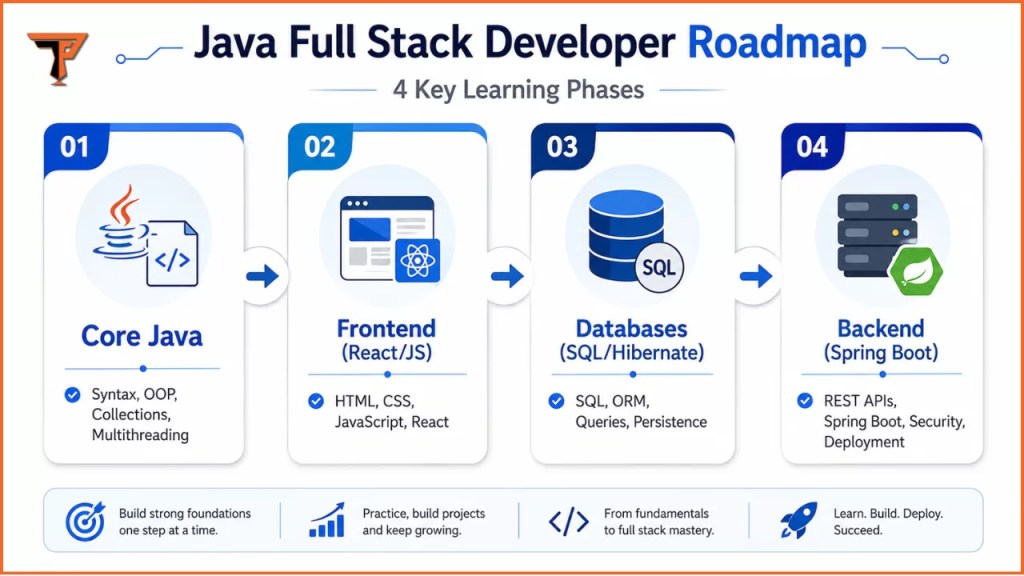
Java Full Stack Developer Roadmap
A full-stack developer handles both the user-facing interface and the underlying server architecture. Once you understand the core language, the next phase involves connecting different technologies to build functional web applications. If you need to master the browser side first, following a structured web development full course is the best starting point.
Frontend with HTML/CSS/JS + Angular or React
Every web application requires a frontend visual structure. You will build user interfaces using HTML for content structure. You then apply CSS for visual styling and JavaScript for complex interactivity. If you are entirely new to browser rendering, an HTML and CSS design guide will clarify the core mechanics. In the enterprise Java ecosystem, developers typically pair their backend with robust JavaScript frameworks like Angular or React to create dynamic single-page applications.
Backend with Spring Boot + REST APIs
The backend is where Java truly shines in production environments. Instead of building web servers from scratch, modern developers rely on the Spring Boot framework to accelerate development. Spring Boot provides production-ready configurations immediately. This allows you to easily build secure REST APIs that transmit data between your frontend and the database.
Databases, Hibernate, and JPA
Software is essentially useless without a way to store and retrieve data reliably. Full-stack developers must understand SQL to interact with relational databases. In the Java ecosystem, you will utilise Hibernate and the Java Persistence API (JPA). These tools map your object-oriented code directly to database tables. This effectively eliminates the need to write repetitive SQL queries manually.
Quick recap: Becoming a full-stack Java developer involves mastering the core OOP language, learning frontend technologies like React, and utilising Spring Boot alongside JPA to manage backend logic and database connections.
Coverage Highlights and Practical Value
Entering the full-stack ecosystem requires strategic decision-making regarding your technology stack. Choosing Java over a JavaScript-exclusive stack offers distinct architectural advantages in large-scale environments. Java’s multithreading capabilities and strict type-checking make it exceptionally resilient for complex applications handling massive data loads. This stability comes at the cost of initial development speed. Prototyping a simple application takes noticeably longer in Java than it does in a lightweight Node.js environment. For startup environments prioritizing rapid launches, JavaScript often wins. For enterprise systems where security, maintainability, and long-term scalability are paramount, Java remains the superior architectural choice.
Best Java Courses in 2026 (Free + Paid)
Navigating the sheer volume of educational content can be overwhelming. To learn Java programming effectively, highly structured learning paths yield the best results. Paid platforms like Udemy offer comprehensive masterclasses. These paid courses often cover everything from basic syntax to advanced Spring Boot deployment.
If you prefer self-paced and budget-friendly options, there are excellent free coding resources available online. Platforms like Codecademy provide interactive browser-based environments. Alternatively, you can download the official Java SE platform directly from Oracle to set up your local workspace and start compiling immediately.
Java Developer Salary and Job Market in 2026
The financial incentive for mastering this technology stack is substantial. Industry data consistently shows that the average salary for a competent Java developer sits comfortably above $100,000 annually in the US market. The demand remains aggressive precisely because massive legacy systems in banking, healthcare, and insurance require ongoing maintenance.
Companies are not just looking for syntax knowledge. They want engineers who understand scalable architecture and system design. The job market continuously rewards those who progress beyond the basics and master the entire full-stack pipeline.
Frequently Asked Questions
Is Java dying in 2026?
No, Java is far from dying. It remains a foundational technology for Fortune 500 companies, massive financial institutions, and native Android application development. Its stability ensures it will remain relevant for decades.
Should I learn Java or Python for jobs?
If you want to work in data science, artificial intelligence, or automation, Python is the better choice. If your goal is enterprise software development, large-scale backend systems, or mobile development, Java offers stronger job prospects.
How long does it take to learn Java?
Mastering the core syntax takes about two to three months of consistent study. Transitioning into a job-ready full stack developer requires an additional six to eight months of learning frameworks like Spring Boot and React.
Is Java a good choice for full-stack development?
Yes, Java is an excellent choice for full-stack development. When paired with a modern frontend framework and Spring Boot for the backend, it creates highly secure, scalable, and resilient web applications.
What is the best Java framework to learn?
Spring Boot is widely considered the industry standard Java framework. It streamlines backend development, simplifies database connections through JPA, and makes building enterprise-grade REST APIs highly efficient.